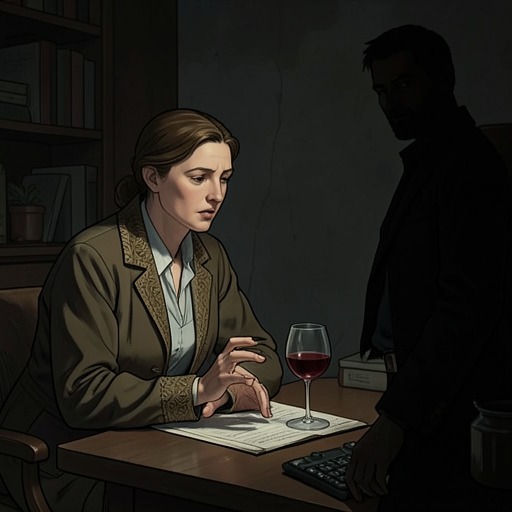
Jasmine Hadley’s heavy drinking
Noughts & CrossesJasmine Hadley’s heavy drinking is a sustained feature of the Hadley household’s decline, visible in the wineglass that accompanies her and in the distance it opens between her and her daughters. Sephy remembers a once-affectionate mother transformed over roughly three years, and later hears Kamal address Jasmine’s drinking with open contempt. The episodes do not explain every source of Jasmine’s unhappiness, but they show how alcohol has become woven into the family’s everyday routines and conflicts.
A Change Sephy Cannot Ignore
Sephy recalls that Jasmine had once been full of smiles, hugs, and jokes. By the time of Sephy’s account, that warmth feels remote: her mother seems persistently miserable, with an expression Sephy describes as fixed in a frown. Sephy links the change to a period of about three years, presenting it not as one isolated bad day but as a long alteration in the atmosphere of home.
The account is filtered through Sephy’s childhood perspective. She does not understand why her mother has changed, and her recollection cannot establish that alcohol alone caused the change. What she can identify is the visible pattern around it: Jasmine’s sadness has become familiar, and Sephy approaches her cautiously rather than expecting comfort or ease.
Wine as a Household Fixture
Later, when Sephy asks permission to hold a party for her fourteenth birthday, she sees Jasmine sipping white wine. The glass is not an incidental detail in Sephy’s description. She has to think back to remember seeing her mother without a glass of Chardonnay in hand, and she observes that Jasmine reads, shops, exercises, or swims, with drinking repeatedly attached to those activities.
Jasmine agrees to the party and advises Sephy to enjoy her teenage years. The kindness of the moment does not erase Sephy’s unease: she wonders how many glasses of wine have brought on her mother’s good mood and resents the glass for seeming to make Jasmine happy where Sephy and her sister Minnie cannot. The scene holds two perceptions together. Jasmine can still be warm and accommodating, yet Sephy experiences that warmth as entangled with alcohol rather than as a dependable expression of closeness.
Strain Between Jasmine and Kamal
The drinking becomes explicit in a rare argument between Jasmine and Kamal. Sephy and Minnie have been sent upstairs after dinner, and their presence on the stairs allows them to overhear their parents. Sephy notes that the arguments are unusual partly because Kamal is seldom home and partly because Jasmine is often too intoxicated—or too refined, as Sephy sees it—to start one.
When Jasmine demands that Kamal stop treating her as he does, he tells her to have another bottle, or eight, and says that this is about all she is good for. The remark makes the drinking a weapon in their marital conflict: Kamal does not raise it gently, but uses it to humiliate and dismiss her. Sephy is struck by his contempt and by the fact that he makes no effort to conceal it. The exchange reveals a household where alcohol is not merely a private habit; it has become part of the language through which the adults attack one another.
Family Consequences and Limits of the Evidence
For Sephy, Jasmine’s drinking helps define the emotional distance between mother and daughters. The birthday conversation shows that Jasmine remains capable of granting her daughter’s request and offering encouragement, but Sephy cannot separate her mother’s good mood from the wine in her hand. Elsewhere, the remembered loss of Jasmine’s former humor gives that present-day image a longer arc: the glass accompanies a change that Sephy has watched but cannot explain.
The evidence presents the drinking through its effects on family perception and interaction: Sephy’s guardedness, her resentment and uncertainty, and Kamal’s contempt during an argument overheard by both daughters. It does not provide a diagnosis or establish a specific treatment, recovery, or final outcome for Jasmine’s drinking. Its significance lies instead in the repeated domestic detail and the contrast it creates between a mother remembered as affectionate and the unhappy, alcohol-associated figure her daughters now encounter.